
Kenmore Directory Collections Compared
No official catalog inspected for this project identifies a continuous Kenmore-only city directory run. That gap matters. The strongest route is a documented mix of local and regional collections, with each source kept under its correct geographic label. The coverage table separates true Kenmore material from Seattle examples that show how a directory entry works.
| Collection | Years | Where Held | Access |
|---|---|---|---|
| King County assessor property cards | 1937-1972 | Washington Digital Archives | Free online search and images |
| R.L. Polk Seattle City Directory | 1891-1893 | Washington Digital Archives | Free online; Seattle, not Kenmore |
| Seattle city directories | 1867-1928 digitized; broader collection described through 1990 | Seattle City Archives | Online regional comparison |
| County and territorial census rolls | 1877 and selected 1879-1892 years | Digital Archives, King County Archives, MOHAI | Online index plus archive routes |
| School registers and censuses | 1890-1936 | Washington Digital Archives | Collection-specific online access |
| Kenmore Heritage Society collections | Local history; no single year run stated | Heritage Society | Free digital categories and referrals |
The absence of a cataloged Kenmore run is not proof that no useful volume exists on a library shelf. Ask staff for the exact title, year, publisher, call number, and geographic scope. Never rename a Seattle volume as a Kenmore city directory merely because a family later lived in Kenmore.
County sources fill the chronological gaps in different ways. The 1877 census and selected territorial or state censuses from 1879 through 1892 provide early names, but their boundaries require care. School district registers and censuses extend from 1890 through 1936. County death registers cover Seattle from 1881 through 1907 and the wider county from 1891 through 1907. Each collection needs its own year and place test before a Kenmore connection is claimed.
Kenmore Library History Search
Kenmore Library, 6531 NE 181st Street, is the practical first stop when a name is missing online. The branch offers computers, printing, scanning, and KCLS research access. The KCLS History and Genealogy collection links to in-library Ancestry access, FamilySearch, Washington Digital Newspapers, Sanborn maps, National Archives material, and more. Hours can change, so verify the branch page before visiting.
Ask a librarian to check directories, telephone books, yearbooks, newspapers, county histories, and microfilm by title. For an obituary request, supply the full name, place and date of death, and publication if known. KCLS handles one request at a time for genealogy or local history, usually searches roughly ten days around the death, and says most requests finish within 14 working days.
The history and genealogy portal shown below is the main gateway to those library sources.
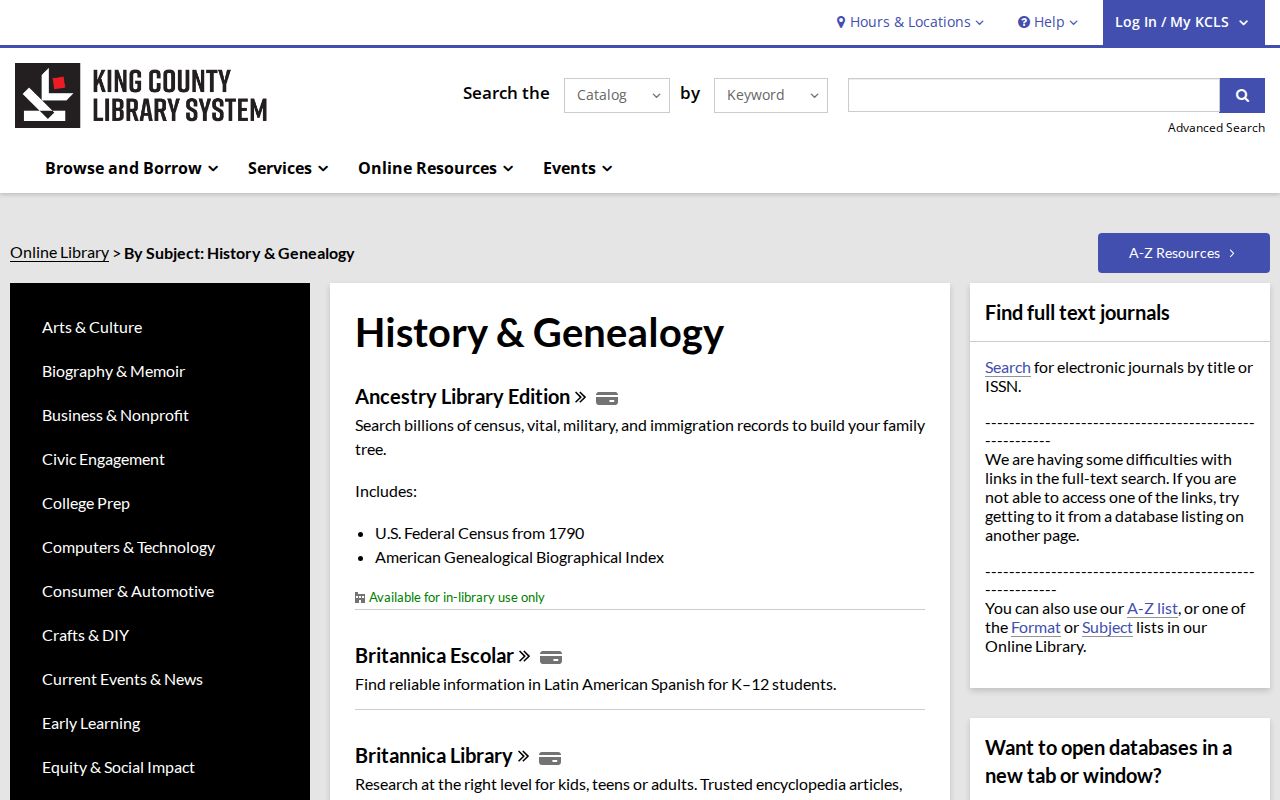
Its databases and staff services help bridge years when no local printed directory can be confirmed.
Regional Directories Need Clear Labels
Washington Digital Archives holds the searchable R.L. Polk Seattle city directory for 1891 through 1893. Search fields include last, first, middle, and Soundex, a spelling-based surname match. Seattle City Archives also presents digitized volumes from 1867 through 1928 and describes a broader city-directory collection from 1890 through 1990.
These runs are valuable models and can document a person who truly appeared in Seattle. They do not establish Kenmore coverage. Kenmore incorporated in 1998, while the local place name is far older. A pre-incorporation search should add county census, school, deed, plat, newspaper, and property-card records instead of forcing the modern city label onto a regional book.
Open the R.L. Polk collection page before searching the catalog.
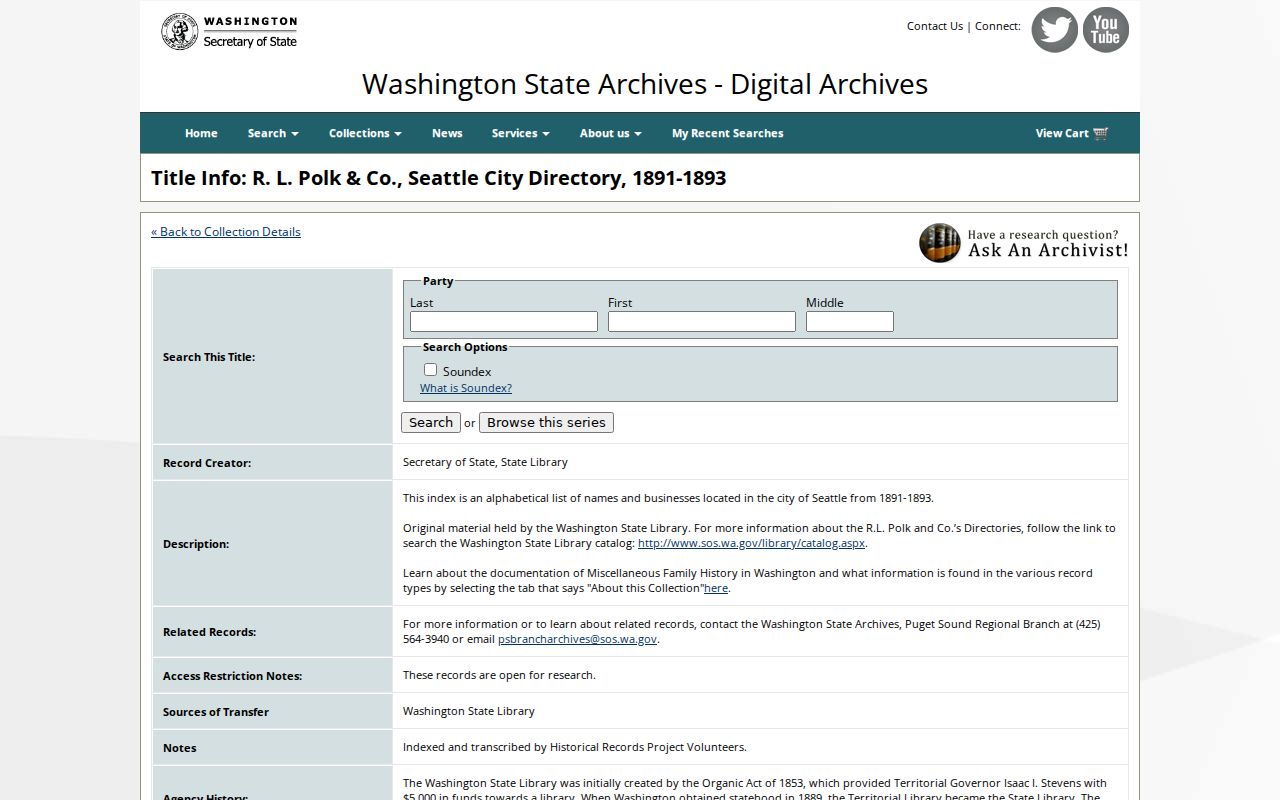
The collection label makes the Seattle scope visible and prevents a regional hit from being misreported as a Kenmore entry.
Read Kenmore Directory Clues
A city directory entry is a compact index, not a full biography. Photograph the title page and abbreviation key with the entry. They establish the publisher, date, coverage, and meaning of short marks. Then transcribe what the line says without expanding an uncertain abbreviation.
| Printed name | Alphabetic name and any middle initial or spelling variant. |
|---|---|
| Household note | A spouse, widow notation, or other relationship only when printed. |
| Work line | Occupation, firm, or business affiliation when the publisher included it. |
| Address | House number and street as they appeared in that edition. |
| Status mark | Owner, occupant, boarder, business, or institution, subject to the volume's key. |
- Criss-cross directory
- An address-first listing arranged by street and house number rather than surname.
- Householder index
- A list centered on the person treated as the main householder by that publisher.
- Abbreviation key
- The volume's own guide to short forms, symbols, occupations, and address marks.
An entry can be a person, firm, school, church, or duplicate name. Match it with a second field before linking it to a Kenmore family.
Kenmore Records Before Digital Rolls
King County assessor real-property cards provide the strongest dated bridge for many Kenmore addresses. The Washington Digital Archives collection covers 1937 through 1972 and reports 82,420 records. Searchable fields include location, parcel number, house number, street name, addition, former building number, former street name, former address, and notes.
That last group is crucial when an old address will not match the current map. A property card documents land and buildings, not every household member. Pair it with a census, directory, deed, school record, or obituary before naming an occupant.
Review the King County assessor-card collection and its stated coverage first.
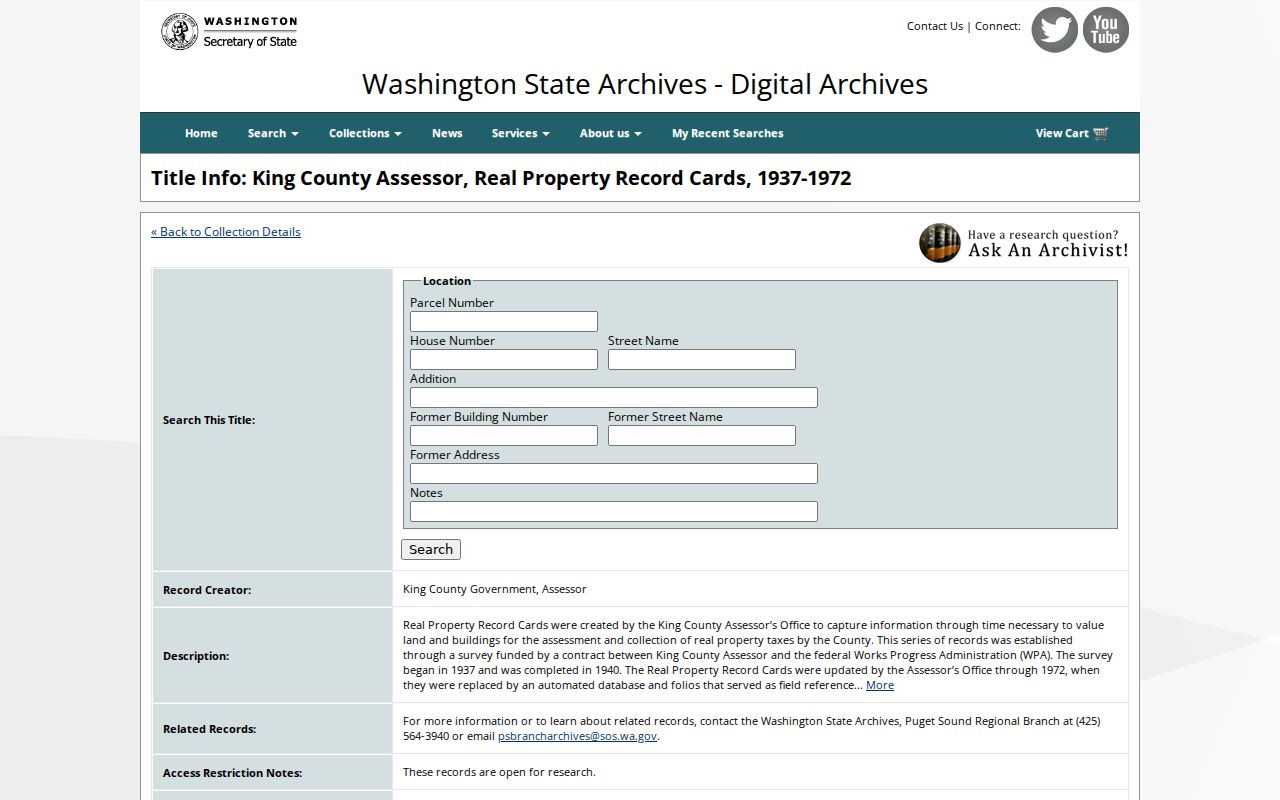
The catalog's former-address fields can reconnect a current parcel with an older street reference.
Kenmore Heritage People Clues
Kenmore Heritage Society organizes digital material by neighborhoods, pioneer families, schools, government, transport, timber, public services, businesses, and community life. It does not publish an all-residents roster. Use its names, images, stories, and place terms as leads, then verify them in the record that created the fact.
Search terms should reach beyond “Kenmore.” Northlake Terrace appeared on an 1892 plat. The McMaster and Kruse mill helped establish the Kenmore name in 1901, and a 1928 fire ended the mill era. Lake Washington, the Sammamish River, SR 522, mills, rail, aviation, and neighborhood names may find a record that predates the modern city.
Search tip. Preserve the source's exact role label, such as owner, pupil, applicant, or obituary subject, rather than calling every named person a resident.
Uplake Terrace Directory Bridge
Uplake Terrace adds a rare property-by-property layer. A 2026 city document describes 102 documented or updated WISAARD entries, including 80 in Uplake Terrace, with digital photographs, a master map, and individual files. The neighborhood association was chartered in 1956. This material can join a house, date, neighborhood story, and parcel search, but it is not an ownership or resident list.
The Uplake Neighborhood Association history gives community context for the survey area.
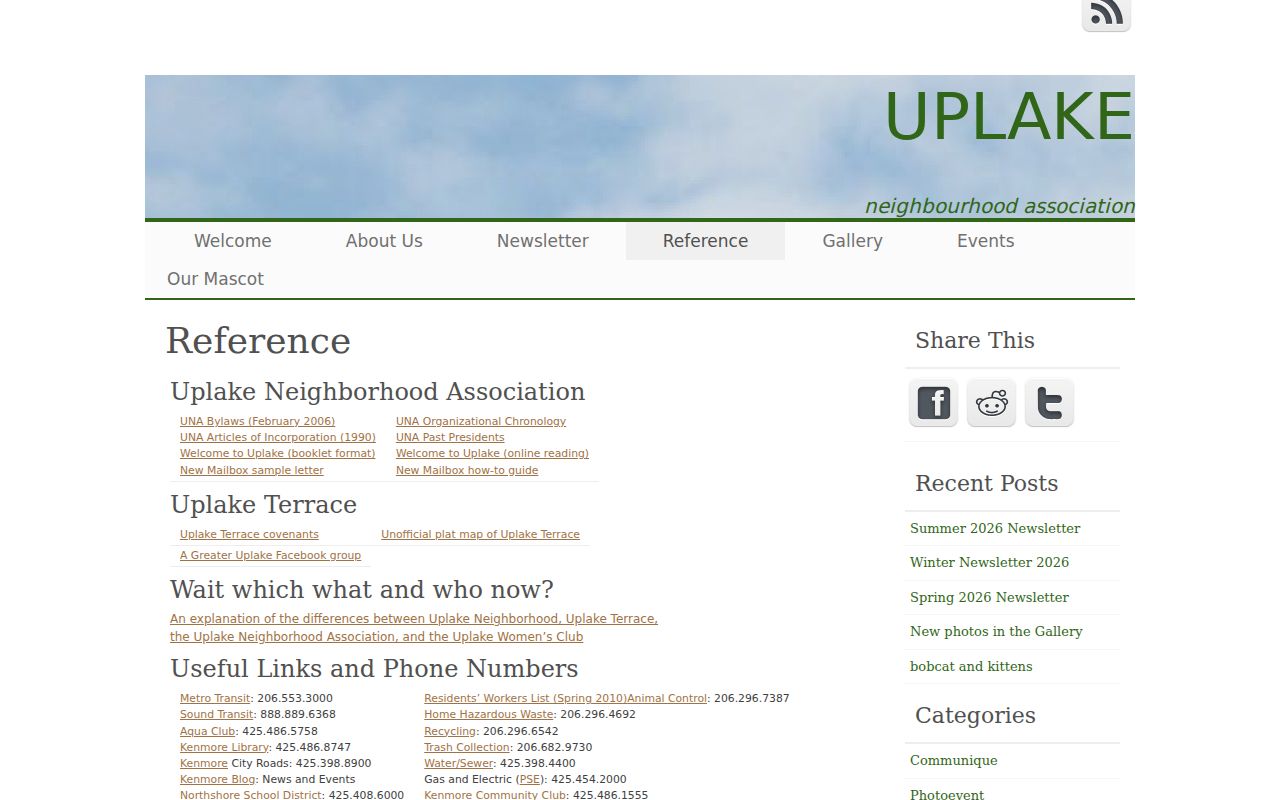
Use a property file as a lead to the parcel card, deed, permit, and dated local source.
Trace Kenmore Families by Directory
Family research is strongest when each change is tied to a year. Start with a name or address and a narrow period. Build forward and backward, while keeping Kenmore, Seattle, and King County sources in separate columns.
- Fix a date range and record the name, address, or parcel exactly as first known.
- Search the 1937-1972 assessor cards and save every former-address note.
- Check the deed and plat chain, using King County Archives for instruments before August 1991.
- Search the nearest directory years, then pair them with released census and school records.
- Test the proposed identity with a newspaper, obituary, spouse, parcel, or distinct occupation.
A missing year can mean a move, death, publication gap, spelling change, or an unlisted household. It proves none of those by itself. The Kenmore resident lookup workflow can help confirm a later name in current official indexes without turning an old directory line into a present-address claim.